I am currently a Ph.D. student in Computing and Data Science at the School of Computing and Data Science, The University of Hong Kong (HKU), advised by Prof. Difan Zou.
My research interests primarily lie in the post-training of Large Language Models (LLMs), including Supervised Fine-Tuning (SFT), Prompt Optimization, and Reinforcement Learning (RL). Additionally, I am interested in the theory of pre-training and learning theories, such as Machine Learning Theory, Optimization Theory, and Reinforcement Learning Theory. I also study learning across pre-training and post-training, test-time learning, and LLM-driven adaptive optimization for complex artifacts. Recently, I have been working on Self-Evolving Agents and Agentic Reinforcement Learning, with a focus on solving harder problems, generating more human-readable and preference-aligned outputs, improving token efficiency, and developing theoretically grounded algorithms with optimization guarantees.
My English proficiency is demonstrated by an IELTS overall band score of 7.0.
My live Google Scholar citation count:

If you are interested in my research, please feel free to contact me via 
🔥 News
- 2026.08: 🎉🎉 LFPO is accepted by EMNLP 2026 Main Conference.
- 2026.05: 🎉🎉 ROSA2 is accepted by ICML 2026.
- 2026.05: We propose BOLT, an offline training framework that mathematically aligns static SFT with the optimal Boltzmann policy in online RLVR, revealing that iterative BOLT strictly functions as Policy Mirror Descent (PMD).
- 2026.04: 🎉🎉 GAPO is accepted by ACL 2026 Findings.
- 2026.03: We propose SAGE, a method that enhances multi-step reasoning in LLMs through a closed-loop, self-evolving framework of four agents (Challenger, Planner, Solver, and Critic) that autonomously generate, plan, solve, and verify tasks using minimal human-labeled data.
- 2026.03: We propose LFPO, which overcomes the likelihood intractability in Diffusion LLMs by directly optimizing denoising logits via contrastive positive/negative trajectories, achieving SOTA performance with significantly faster inference. Check our Github.
- 2026.03: We propose ROSA2, which reformulates test-time adaptation as a co-adaptation framework that jointly optimizes interaction context and model parameters to significantly accelerate convergence speed. Check our Github.
- 2026.01: 🎉🎉 R-Score is accepted by ICLR 2026.
- 2025.12: 🎉🎉 ReDit is accepted by NeurIPS 2025.
- 2025.11: 🎉🎉 UniSVG is accepted by ACM MM 2025 Dataset Track.
- 2025.11: 🎉🎉 PAFT is accepted by EMNLP 2025 Main Conference and receives the SAC Highlight Award (Top 2%).
- 2025.10: I serve as a reviewer for ICLR 2026.
- 2025.10: We propose GAPO, a method that robustly handles skewed reward distributions with outliers in code-editing RL by adaptively computing advantages, leading to consistent performance improvements. Check our Github.
- 2025.10: We propose R-Score, a novel metric to quantify the learnability of queries in RL to enhenced the curriculum learning method. Check our Github.
- 2025.09: We propose ROSA, a lightweight algorithm for our test-time adaptation paradigm that enables LLMs to perform efficient in-conversation self-correction by updating parameters online using real-time user feedback. Check our Github.
- 2025.08: We propose UniSVG, a SVG dataset for improving MLLM SVG generate performance. Check our Project Page and Hugging Face.
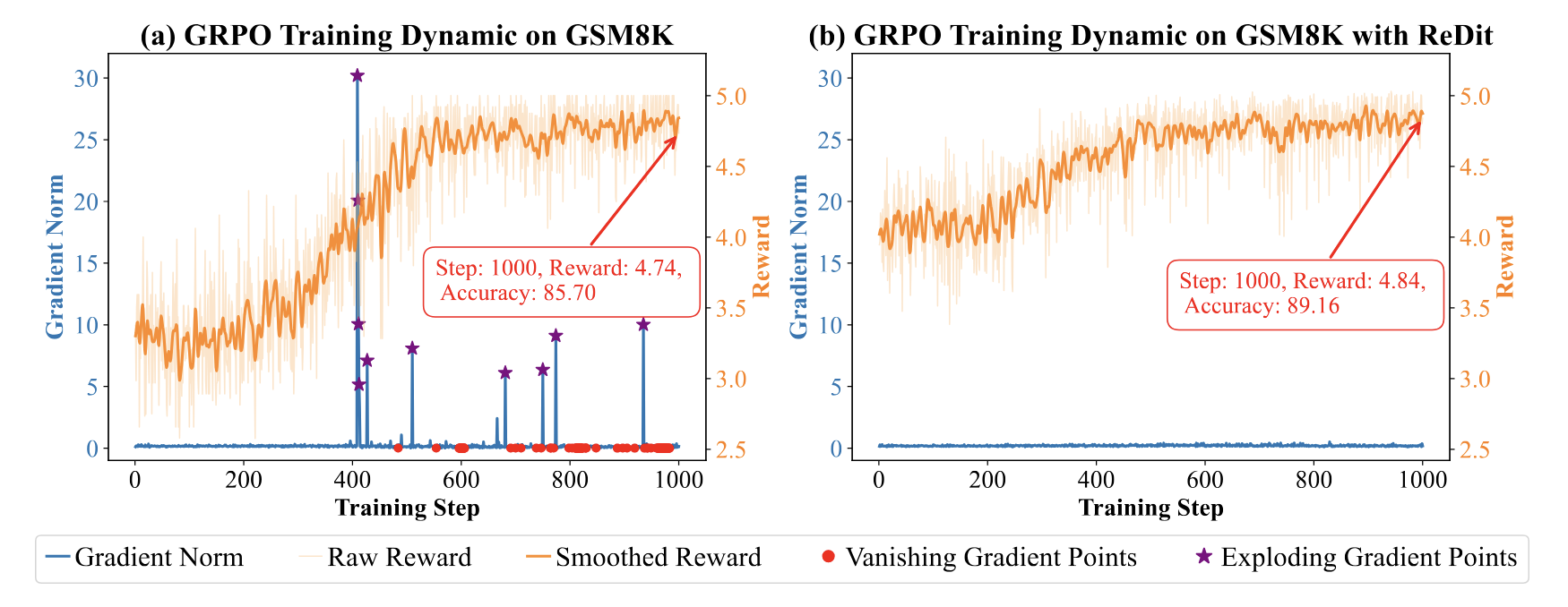
- 2025.06: We propose ReDit, a technique that enhances reinforcement learning in large language models by adding random perturbations to reward signals, improving training efficiency and convergence speed while maintaining performance. Check our Github.
- 2025.06: 🎉🎉 Flexora is accepted by ACL 2025 Main Conference.
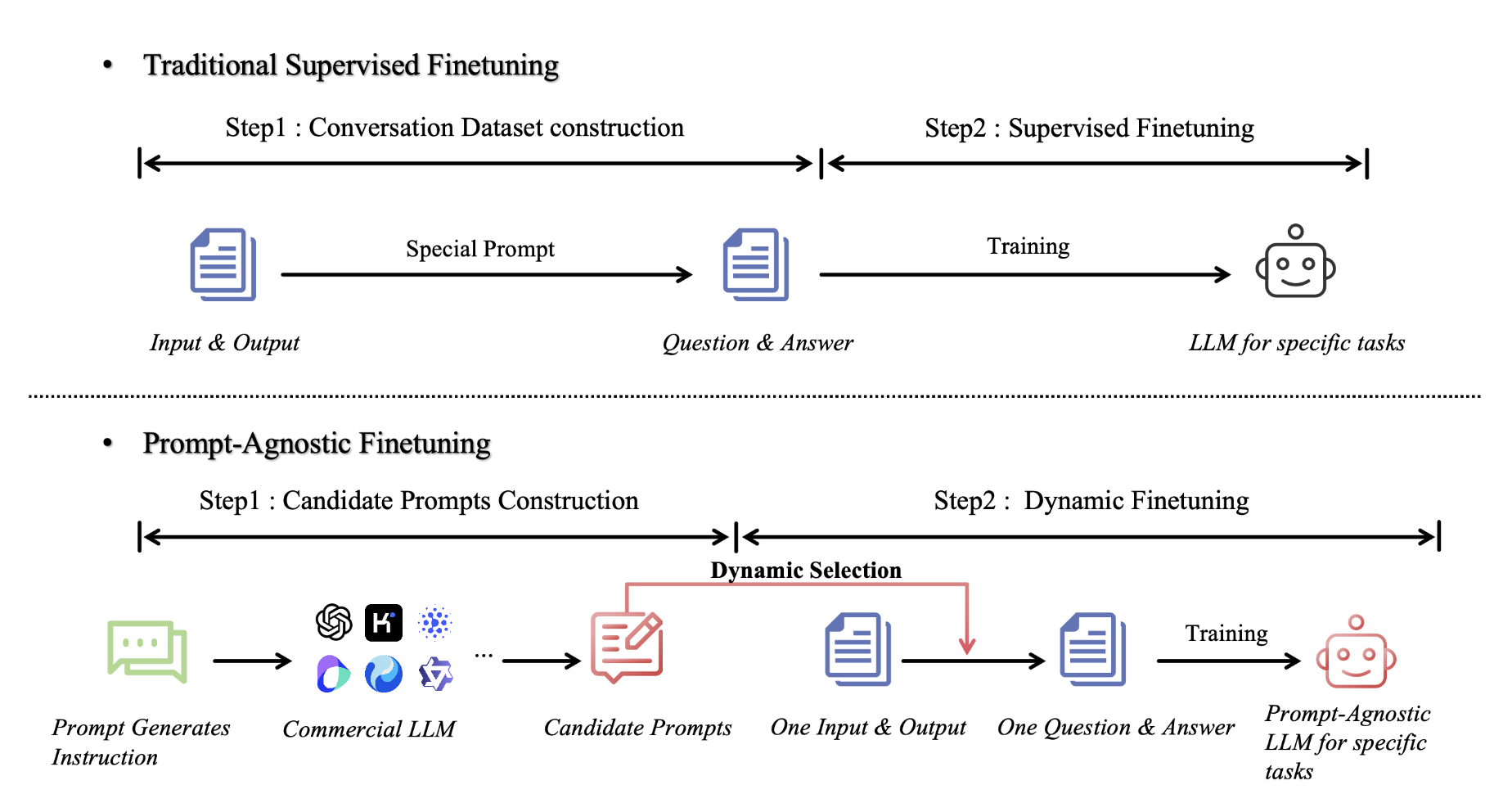
- 2025.02: We propose PAFT, which dynamically adjusts prompts during training, improving robustness, generalization, and even inference speed. Check our Github.
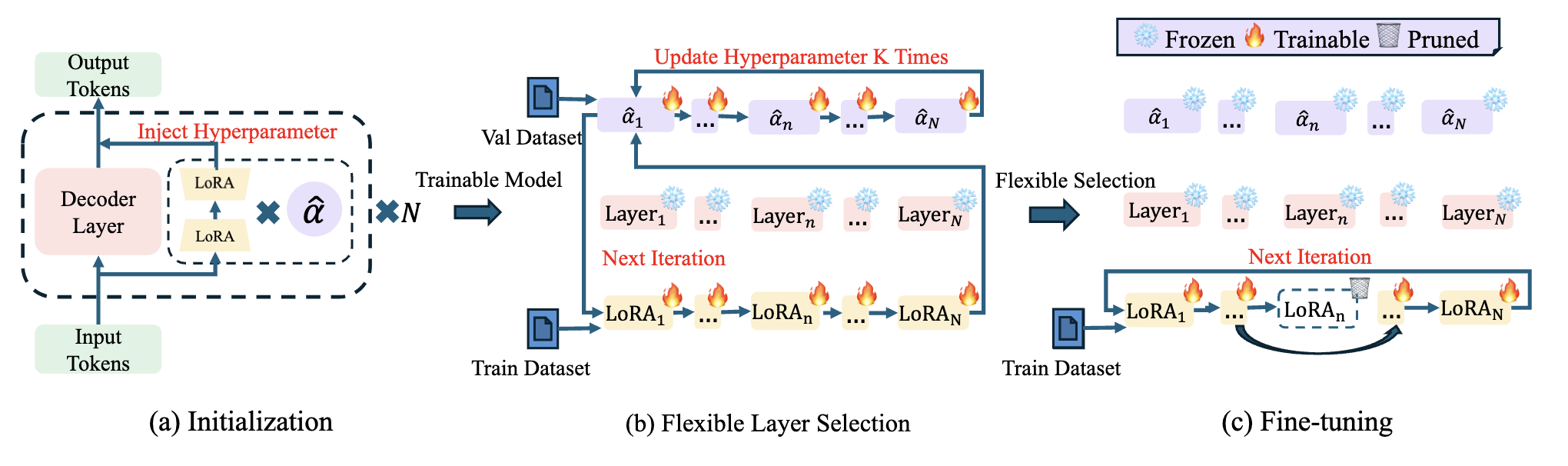
- 2024.08: We propose Flexora, a novel method that enhances Large Language Model fine-tuning efficiency by selectively adapting only the most critical layers. Check our Github.
- 2024.02: We propose Data Interpreter, an LLM agent for solving data science problems. Check our Github.
📝 Selected Publications
† Equal Contribution
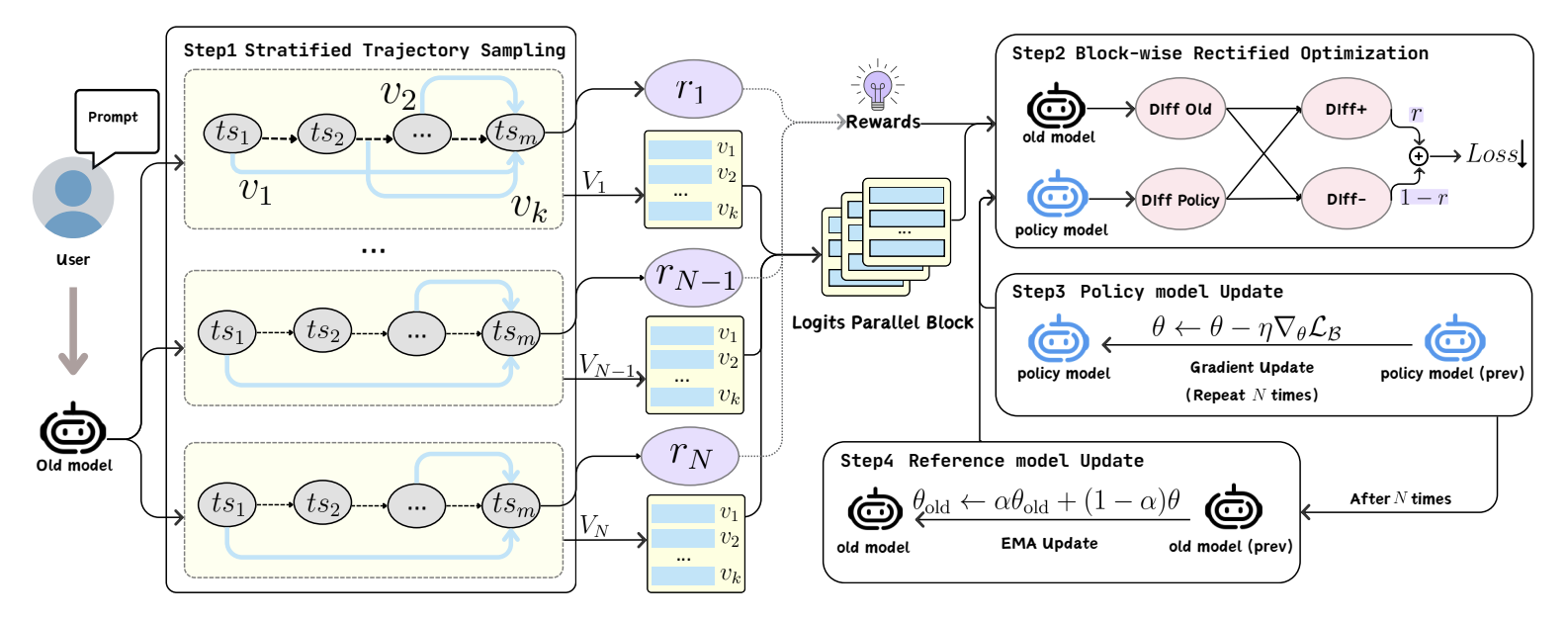
LFPO: Likelihood-Free Policy Optimization for Masked Diffusion Models
Chenxing Wei, Jiazhen Kang, Hong Wang, Jianqing Zhang, Hao Jiang, Xiaolong Xu, Ningyuan Sun, Ying He, F. Richard Yu, Yao Shu, Bo Jiang
- Algorithm (LFPO): Introduces LFPO, which overcomes the likelihood intractability in Diffusion LLMs by directly optimizing denoising logits via contrastive positive/negative trajectories, achieving SOTA performance with significantly faster inference
- Theory: Proves the theoretical equivalence of continuous Flow Matching and discrete Masked Diffusion, justifying efficient trajectory rectification beyond policy gradients
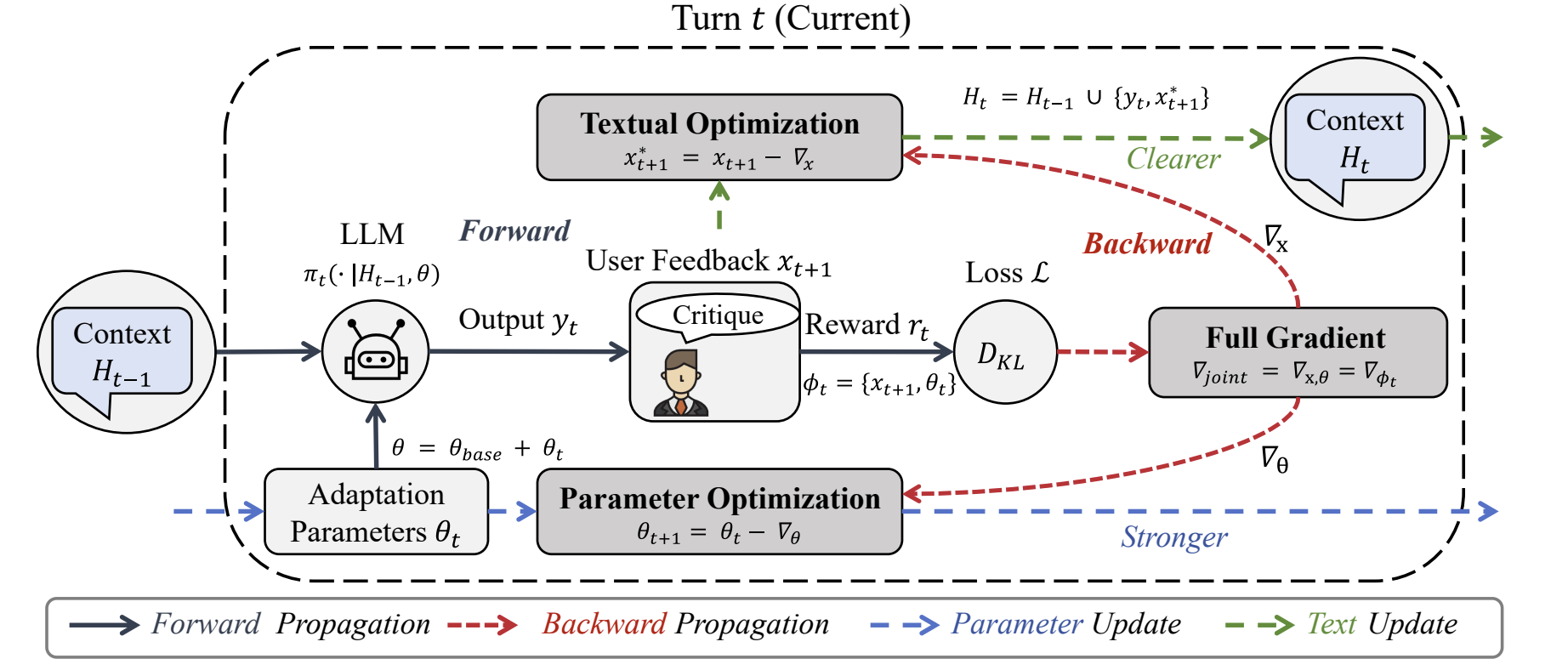
Words & Weights: Streamlining Multi-Turn Interactions via Co-Adaptation
Chenxing Wei, Hong Wang, Ying He, Zhongxiang Dai, Bo Jiang, F. Richard Yu, Yao Shu
- Algorithm (ROSA2): Introduces ROSA2, which reformulates test-time adaptation as a co-adaptation framework that jointly optimizes interaction context and model parameters to significantly accelerate convergence speed
- Theory: Rigorously proves that semantic refinement acts as a pre-conditioner to strictly reduce parameter shift and guarantee faster convergence to the optimal policy
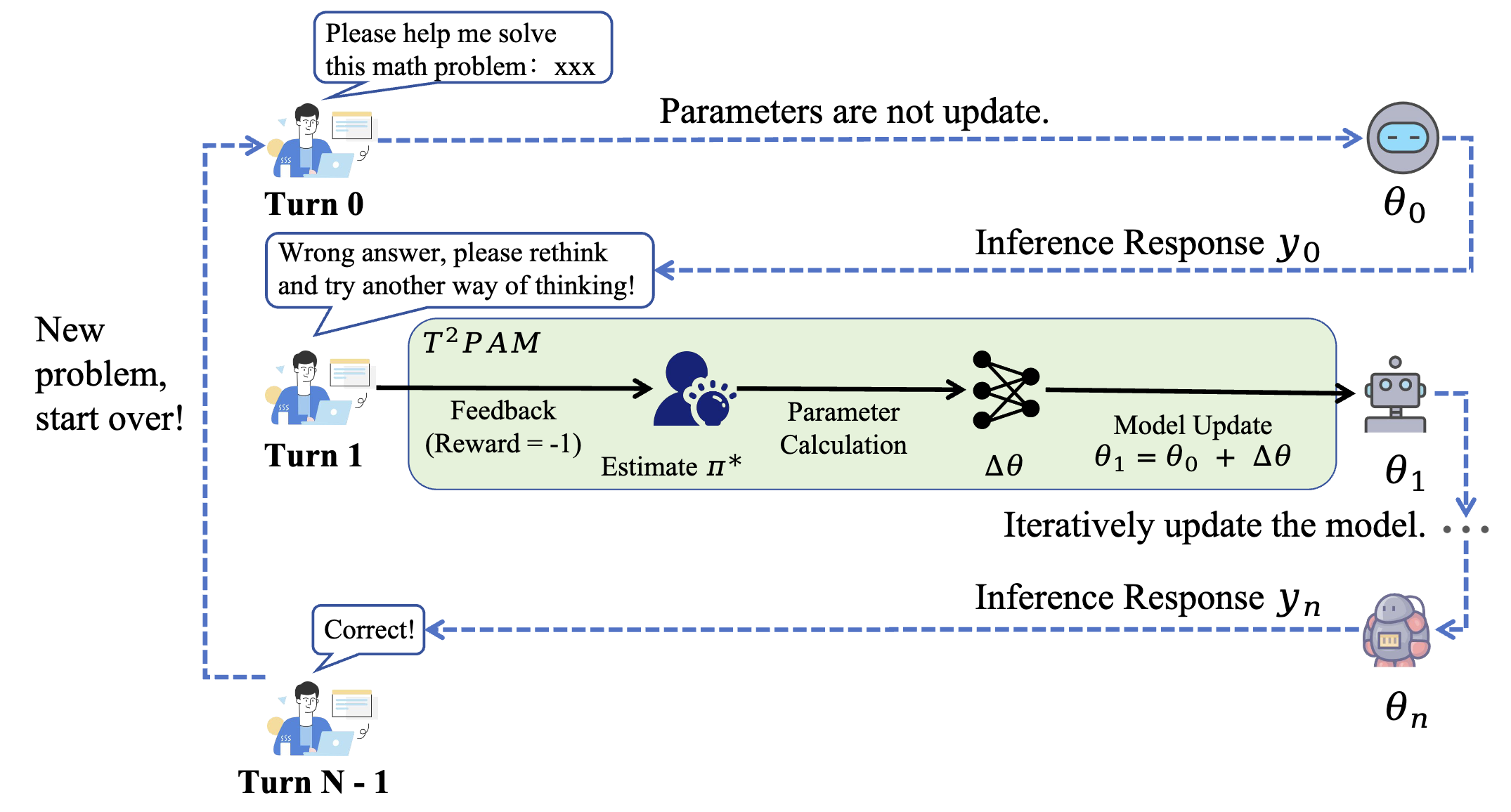
Test-Time Policy Adaptation for Enhanced Multi-Turn Interactions with LLMs
Chenxing Wei, Hong Wang, Ying He, Yao Shu, Fei Yu
- Paradigm (T2PAM): Proposes a paradigm shifting alignment from offline training to test-time inference, utilizing conversational feedback for real-time policy updates
- Algorithm (ROSA): Introduces ROSA, a lightweight algorithm that performs single-step, analytical parameter updates for efficient in-conversation self-correction
- Theory: Proves monotonic error reduction at each turn and guarantees cumulative convergence to the user’s optimal preference
ReDit: Reward Dithering for Improved LLM Policy Optimization
Chenxing Wei, Jiarui Yu, Ying Tiffany He, Hande Dong, Yao Shu, Fei Yu
Paper | OpenReview | GitHub
- Algorithm (ReDit): a method that injects zero-mean random noise into rewards to smoothen the landscape, enabling continuous and stable gradient estimation.
- Theory: proves that reward dithering effectively mitigates gradient anomalies (vanishing/exploding) and significantly accelerates convergence.
PAFT: Prompt-Agnostic Fine-Tuning
Chenxing Wei, Mingwen Ou, Ying Tiffany He, Yao Shu, Fei Richard Yu
- Algorithm (PAFT): Introduces PAFT, which minimizes the divergence between predictions from full prompts and “pattern-free” inputs, effectively decoupling task reasoning from specific instruction syntax.
- Theory: Theoretically guarantees reduced generalization error under prompt distribution shifts and empirically achieves state-of-the-art robustness.
Flexora: Flexible Low-Rank Adaptation for Large Language Models
Chenxing Wei†, Yao Shu†, Ying Tiffany He, Fei Richard Yu
- Algorithm (Flexora): Introduces Flexora, a framework that treats layer selection as a Hyperparameter Optimization (HPO) problem. It employs unrolled differentiation to automatically learn a policy that identifies and adapts only the most critical layers for specific downstream tasks.
- Theory: Provides theoretical insights into how automated, flexible layer selection effectively mitigates overfitting and enhances generalization compared to uniform adaptation.
🎡 Service
- Reviewer for ICLR 2026
- Reviewer for NeurIPS 2026
- Reviewer for EMNLP 2026
🎖 Honors and Awards
- 2026.06 Outstanding Graduation Thesis Award, Shenzhen University
- 2026.06 Outstanding Graduate, Shenzhen University
- 2025.11 SAC Highlight Award (Top 2%), EMNLP 2025
- 2025.10 National Scholarship, Shenzhen University
- 2025.09 First-Class Academic Scholarship, Shenzhen University
- 2023.09 Second-Class Academic Scholarship, Shenzhen University
- 2022.06 First Prize in the TI Cup National Undergraduate Electronics Design Contest, Nanjing University of Aeronautics and Astronautics
- 2021.06 First Prize in the Contemporary Undergraduate Mathematical Contest in Modeling, Nanjing University of Aeronautics and Astronautics
📖 Education
-
The University of Hong Kong

Ph.D. Student in Computing and Data Science, School of Computing and Data Science, 2026.09 - Present (Expected 2030)
Advisor: Prof. Difan Zou
-
Shenzhen University

Master, Computer Science, 2023.09 - 2026.06,
Advisor: Prof. Fei Richard Yu, Co-Advisor: Prof. Yao Shu
-
Nanjing University of Aeronautics and Astronautics

Undergraduate, 2019.09 - 2023.06,
Advisor: Prof. Hanlin Sheng
💻 Internships
-
ByteDance

Algorithm Intern, Trae Team, 2025.10 - 2026.06,
Main contributions:
- Research on reinforcement learning for DLLM in code modification and proposes LFPO.
- Research on integrating browser-use agents with code generation agents for harness-guided web code improvement.
-
Tencent

Algorithm Intern, CSIG - CodeBuddy Team, 2025.02 - 2025.09,
Main contributions: Research on self-play reinforcement learning framework for GUI agents.
-
Tencent
Algorithm Intern, AI LAB, 2024.06 - 2024.12,
Main contributions: Research on emotion and action prediction model of the game NPC.
👾 Misc
